Friday, May 21, 2010

The Unblinking Ear Podcast: The Terrible Twos

(Above: A fearsome twosome)

With this post, I have now been doing my podcast for just over two years.

I don't expect recognition of this anniversary that Google granted Pac-Man today.

If you want to buy me a piece of cake, I will gladly eat it.

Or you can follow me on Twitter, which I'm doing now because it's 2010 and you have to.


Download the latest The Unblinking Ear Podcast
Or Subscribe via iTunes

Tuesday, May 18, 2010

Used Bin Ubiquitous Bargains: The Blasters

Used Bin Ubiquitous Bargains is a new feature wherein I recommend LPs I frequently see fallowing in the used bins of record shops despite their quality and reliably low sticker price. They are the albums you can find easily, will only set you back 5 beans or less and are probably better than the whatever the hype machine is praising this week.

The Blasters' self-titled album is a perfect candidate. It was popular enough to make it all the way up to #36 on the Billboard chart on 1981, thus many copies are in circulation. Plus, I'm sure those who haunt record shops are unlikely to take a chance on the album based on the cover, which has to be one of the ugliest in rock history. It looks like an unskilled artist was airbrushing the cover of the first King's Crimson album from memory on to the back of somebody's jean jacket. Ironic, considering the Blasters play pretty much the aesthetic opposite of King Crimson's prog rock.

While the Blasters are usually referred to as "rockabilly," that's not strictly true. "Rockabilly" has become a sort of shorthand for all pre-British Invasion rock n' roll, encompassing 50s country, blues, roadhouse R&B as well as legitimate rockabilly. The Blasters draw from all these styles and do so exceptionally well. While their recreation of early rock n' roll is certainly derivative, it never comes off as pandering or as mere affection, as it does with, say, the Stray Cats or someone. Rather, it plays like a celebration of "American Music," to borrow the title of one of the band's more popular songs. The enthusiasm the band has for the source material is both obvious and infectious.

Despite their traditionalist bent, the Blasters were birthed through the L.A. punk scene of the late 70s and early 80s. Singer/songwriter/guitarist Dave Alvin actually did stints in X and the Flesh Eaters. While this may strike some as somewhat surprising, it actually makes a world of sense. The L.A. scene was extremely open minded went it came to supporting different kinds of music and was especially interested in the primitive hoodoo of early forms of rock n roll as the antithesis of the bloated sounds of 70s mainstream rock. Alvin, for his part, has stated that he was inspired just as much by seeing Johnny Rotten on TV as he was by Johnny "Guitar" Watson and Chuck Berry. (A dubious claim but we'll take him at his word.) While bands like X and the Gun Club infused their love of vintage rock n' roll and blues with a more aggressive sound, the Blasters happily played it straight. As the most conventional band in the scene, it's unsurprising they were the most commercially successful. Their moderate fame foreshadowed the rise of "roots music" and "Americana" in mid-80s mainstream rock in the forms of Springsteen, Mellencamp and their ilk. This was partially a reaction to the popularity of the stylized new wave groups that were dominating MTV at the time, commonly and pejoratively referred to as "English hair bands." (SST's Joe Carducci humorously surmised the situation as "flag wavers vs fag wavers.") More insidiously, another factor may have been the nostalgia for an idealized 1950s-that-never-existed were so prevalent in Reagan's America.

Regardless of socio-political content, The Blasters is probably the only musical relic of the 80s infatuation with the 50s that you need to own. Below are two cuts from the album: their version of Little Wille John's "I'm Shakin" (one of many covers in the Blasters' repertoire) and the original "So Long Baby Goodbye." If you want to hear more, you'll undoubtedly find The Blasters in a used LP bin near you for a very reasonable price. And if you're lucky, your copy will include a one page catalog for Slash Records merchandise. A Decline of Western Civilization blue v-neck t-shirt? Where do I send my money?

Monday, May 17, 2010

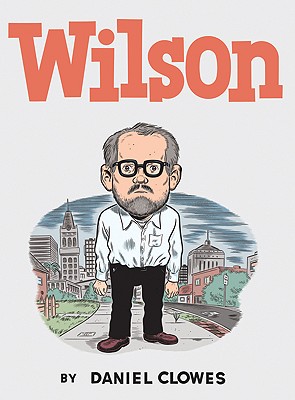
The Many Misanthropic Moods of Wilson

I'm going to take a break from the usual music coverage offered in this space (not that the music coverage is so prolific that it needs a break) to discuss one of the few other subjects about which I know something, comics. In particular, the recently released graphic novel, Wilson.

Wilson is the first stand alone comics work from Daniel Clowes in six years. To non-comics fans, Clowes is probably best known as the creator of Ghost World, both as the author and artist of the original graphic novel and the screenwriter of its successful film adaptation. However, to those who follow his medium, Clowes is one of the most renowned comics-auteurs, his work among the most influential in independent comics. As his first major work after his extended furlough (aside from a series of single page comics that appeared in the New York Times magazine) anticipation for Wilson was perhaps impossibly high. While it may initially feel like a bit of disappointment in that context, Wilson is throughly rewarding on its own merits.

In Wilson, Clowes reuses the single page format from his Times work, Every page is a "gag strip." That is, each page is set up as its own little story, building to a punchline in the final panel. Taken together, the strips form a years-spanning narrative for its title character, a miserable middle-aged misanthrope who incorrectly identifies himself on the book's opening page as a "people person." One might assume that Clowes is deconstructing (or re-constructing?) the Sunday newspaper cartoon strip, suggesting that individual strips are fragments of a greater character arc.

However, unlike the affable characters one usually finds the in the Sunday funnies, Wilson has to be one of the more aggressively unlikeable protagonists in fiction. Within a few pages, he reveals that he left his wife while she was pregnant, torments his former in-laws and starts conversations with strangers only to berate them. Wilson is a smug, deluded blowhard and the book wrings a lot of laughs from his interactions with the world. In one of the book's funniest sequences, Wilson pontificates away typically until another character finally divulges her feelings of deep ambivalence toward a family member. After this gut-wrenching revelation, Wilson's response is a flippant "Hey! It talks!" It's refreshing to see Clowes employ his trademark twisted sense of humor again. While his recent work like Ice Haven, David Boring and The Death-Ray were widely (and justly) acclaimed, there was little trace of the man who gave the world hilariously warped comedy pieces like "Sensual Santa" and "Needledick, the Bug Fucker." While Wilson is not a pure "humor" book by any stretch, it's good to see Clowes hasn't lost his touch when comes to bringing the funny.

One could easily spend hours contemplating the implications of Wilson's empathy-discouraging eponymous character, just as one could with protagonists from similar cringe-comedies like Curb Your Enthusiasm or The Office. But its format is what's most awe-inspiring about Wilson. Clowes has used a somewhat similar formula before. Ice Haven was built on a series of strips which, at first, only seemed to be tangentially related but eventually added up to a whole narrative. However, he has not attempted a format quite as rigid as this before. Yet he mines a surprising amount of depth out of what would seem to be a very limiting structure. Details that are seemingly minor have major effect later on. Key information is held back and when revealed makes the reader view the prior pages in a whole different light. The fact that each page works individually while the whole works collectively is nothing short of stunning.

Clowes further showcases his skill by shifting his drawing style throughout the book. Some pages are in a simple, cartoony Peanuts-style. Others are more detailed, inching closer to photorealism. And there's all manner of degrees in between. Yet every panel is distinctively Clowes. A minor gripe is that while the breadth of styles is impressive, in no way does it inform or enhance the story. Unlike a book like David Mazzucchelli's Asterios Polyp, where the way certain characters were drawn were as essential to their nature as the text, here the different visual styles seem to serve no purpose other than for Clowes to dazzle the reader with his ability. There's nothing wrong with that, per se, and the variety probably makes Wilson a more exciting read than if it had been drawn in a uniform style. But it seems like a bit of missed opportunity. Some have commented that there is a rationale for the style of each page, saying that more cutesy the rendering, the more the characters are suffering. Perhaps it's my ignorance, but I see no evidence of any correlation.

For those unfamiliar with Clowes' work, Wilson is probably not the best place to start. (Get yourself a copy of Ice Haven and proceed from there.) However, it's highly recommended to both fans of Clowes and fans of independent comics in general. The preceding sentence might be a bit redundant. Such is Clowes' legacy that those two groups are more or less synonymous.

Thursday, May 06, 2010

Out of Print (Bootleg Vinyl) Relics: Killed By Death- British D.I.Y.

Though I'd like to think that everyone who reads this blog is on the exact same wave-length as me, I feel that it would probably be best if I explained both halves of the subtitle of this post.

Killed By Death is series of bootlegs collecting extremely rare vintage punk singles, mirroring the model used by the Pebbles series for rare 60s garage rock. The debut volume appeared in 1989 and while it wasn't the first collection of rare late 70s/early 80s punk rock, it was the first of it's kind to spawn sequels. The first four were were put together by the same compiler and were hugely popular with punk collectors. Despite making household names out of the likes of Mad Virgins and Ebenezer and the Bludgeons, said compiler eventually dropped the project.

A few years later, another enterprising soul realized that since the series was quasi-legit (at best) bootlegs, the original complier had no rights to the name Killed By Death. So, this soul put together his own collection of rare punk and slapped Killed by Death 5 on the front. Thus, the floodgates opened and soon every punk collector with a few elusive singles in his collection was putting out a Killed By Death of his own, numerical consistency and quality control be damned. For the inside scoop on this phenomenon from one of the many bootlegers, click here.

The series peaked in the mid-90s, with over 20 seperate editions of KBD (not to mention numerous other comps with different monikers) coming out between 1995 and 1998 alone. Its impact on the garage punk scene of the mid 90s (soon to memorialized in Eric Davidson's We Never Learn) cannot be overstated. Eventually, the series petered out as the law of diminishing returns set in. There were only so many insanely-awesome, insanely-rare punk rock stompers to be unearthed.

In 1998, one compiler decided to go a slightly different route. While the well was running dry on punk singles, its artier but just as amateurish offshoot, D.I.Y. ("do-it-yourself"), was all but undocumented. So this compiler assembled this collection and renumerated the series at "Vol. 1," joking there was no way to tell which volume of the Killed By Death series was "next," so he just decided to start over again.

As for what D.I.Y. is... well, a less than elucidatory shorthand is that it's not that dissimilar to "post-punk," as that term is conventionally understood. It's actually a subset of post-punk though it tends to be more ramshackle and is much less likely to have had any kind of corporate backing than other varieties. For that matter, it's less likely to have had any kind of music industry connection at all. I'll leave it to Chuck Warner, the creator of the Messthetics series, to explain much more conclusively:
Messthetics is about something truly important and vital that really DID happen after the punters took up the cry of "punk is dead" (And no, we don't mean Joy Division.) And in its way, DIY was just as revolutionary as punk.

However proletarian punk was at the musician level (say, 70% in the U.K., 2% in the U.S.), it became business-as-usual almost instantly in terms of manufacturing and marketing. Sure, Stiff and Radar stayed independent for a couple of years, but even before the Sex Pistols got to EMI or A&M, they were cutting acetates at Abbey Road.

The Desperate Bicycles set the initial standard for the Do It Yourself alternative. To cut mastering costs in half, they pressed the same two songs on either side of their first two singles (August '77 and Feb. '78), and they recorded in one take. Younger fans may be surprised at their printed sleeves and labels [one side only, natch], but in 1978, both letter-press and offset printing were cheaper than photocopying, even in quantities of a couple hundred (although a surprising number of UK DIY 45s came in editions of 1000 or more). But the true rallying cry of DIY came from the 'Bicycles' "The Medium Was Tedium:" "It was easy. It was cheap. Go and do it!"

While punk fizzled in '78 in a wave of tunelessness and gobbing, more timid bands either plugged away at over-hyped (and again, tuneless) skinny-tie pop [Pleasers, Boyfriends] or diluted whatever other fresh ideas they might have had with ever-more expensive gear and slicker production values. So meanwhile John Peel and others were only too happy to play and promote the rising tide of self-produced, home-made vinyl. (The U.K. listings for Volume were chiefly compiled from Mr. Peel's archives: if a DIY record is not listed, chances are good that the band never sent him one.) But back to budgetary matters:

Bands were more likely to list their production costs than to list their band-members' names. They were highly competitive about the former...and quite egalitarian about the latter, which were frequently given only as indeterminate three-letter grunts: Gez, Baz, Kaz, Daz, Loz, Tag, Jaf, Nik, Nag, etc. (This annoying habit became a veritable art form in the Oi era, of course.)

A great deal of the DIY "sound" is characterized by wheezy unreliable keyboards. Since they'd gone utterly out of fashion and/or having been superceded by newer electronics, Voxx Continentals and Rolands and Farfisas and Fender-Rhodeses and even a few Hammonds had become as cheap or cheaper than guitars in 1978. And every crappy studio still had a rattly old piano in the corner. Other common non-punk elements are hippie-psychedelic guitar chops, and bass-lines lifted rather directly from JJ Burnel of the Stranglers (an underappreciated genius of some magnitude). Oh yeah, and hardly anyone ever worried about their tunings or musicianship...

Messthetics posits a DIY-centric universe, so this series is inclusive, not exclusive. For instance, after the DIY sound had been around for a while, certain more established or commercially successful bands began to record songs that were musically indistinguishable from the real thing. They're here. Likewise, a bunch of DIY bands recorded straight-ahead punk songs (that regularly turn up on KBD-style comps). And some of those are here, too.
This KBD volume is possibly the first attempt to contextualize this movement, predating Chuck's Messthetics. It's by no means definitive. D.I.Y. stalwarts Desperate Bicycles, the Homosexuals and early Scritti Politti are not present. Still, it's a fine introduction, collecting many excellent sides from UK D.I.Y. bands (and a ringer from New Zealand) released between 1978 and 1981. It's also one of the few Killed By Deaths not already uploaded on the web by somebody which is why I'm sharing it with you all now.

Below are a couple of representative tracks and a link to download the full album. If you like what you hear, I highly recommend you purchase one (or several) of the Messthetics comps. You can also check out the frequently-Googled post I made many moons ago on the Four Plugs, whose "Biking Girl" is #12 on an entrepreneurial gentleman's list of the top 100 D.I.Y. singles. If you're interested in the Killed By Death series as a whole, there are some fairly comprehensive lists of it and other like-minded collections like Bloodstains available online. Caveat emptor: later volumes of the series are rather dire. Stick with the first four and proceed with caution from there.

Tuesday, May 04, 2010

The Unblinking Ear Podcast: In Lieu of a Review...

...here's some actual music.

Yes, it's a Tuesday. And perhaps some of you thought I might be featuring a new release. Certainly, one or two were worth mentioning. However, you probably know about them already and I generally prefer to devote this space to records that are a bit more under the radar (or, alternately, records about which I think have something particularly interesting to share.) This is sort of ironic considering that this blog is probably much more obscure than the bands themselves.

Or maybe it's just a cynical attempt to generate Google hits with timely material and offer a little quid pro quo to the publicists who keep generously sending me albums. That's something to think about as you listen to the music below.


Download the latest The Unblinking Ear Podcast
Or Subscribe via iTunes

Tuesday, April 27, 2010

New Release: Wounded Lion

Today sees the release of the self-titled debut album by Wounded Lion on the reliably superb In The Red label. I was on the fence on whether or not to feature this album as a new release. While it's more than worthy of a recommendation, I was struggling for anything insightful to say about these dozen tracks of affable garage pop. In preparation for this review, I wound up filling two pages of my handy reporter's notebook with solipsistic nonsense. I'll spare you the details. (Who says there's no editorial standards in blogging?)

Back to matter at hand, as I debated reviewing Wounded Lion I wound up listening to it quite a bit. With each listen, it grew on me considerably and I ultimately decided that my probable lack of worthwhile exegesis should not stand in the way of alerting you, dear reader, to this fine collection of songs.

Wounded Lion are not dissimilar to fellow Californians Nodzzz in their mix of rough simplicity and unrelenting catchiness. Actually, the band(s) I was reminded of most when listening to this platter were Big Dipper and the Embarrassment. Songs like "Hunan Province" and "Belt of Orion" seem to have inherited their sense of melody directly from Bill Goffrier's old bands, sources that are both fertile and infrequently replicated. This is not to suggest that Wounded Lion are merely derivative. Rather, they simply have fine apparent taste in influences. (Others according to their Facebook and MySpace pages: The Equals, Ivor Culter, The Eyes, The Sweet and Can. No qualms there.) And I would hope that readers of this page would know that any comparison to Big Dipper or the Embos should be considered a huge compliment. One can do a lot worse than blister pop for the 21st century.

Give this one listen. You may well wind up giving it several dozen more before you grow tired of it. Also be sure to check out their highly-entertaining, shoestring-budget video for "Pony People" below. Feel free to share it with your friends. It's just as meme-worthy as Lady Gaga's latest and doesn't feature any ironic-but-compensated-for product placement.

Wednesday, April 21, 2010

Do I Sound Like This?


(Video from the Village Voice. Link courtesy of Ben Johnson.)

Eh... maybe not. My speaking voice is much more lovely.

Update: First of all, I'd like to apologize for the fact that this video plays without prompting as soon as the page loads. I'm aware this is the reason we all left MySpace for Facebook. If it didn't think it was important (or at least pertinent) viewing for most of you, I'd consider removing this post entirely.

Secondly, I wanted to add some of my thoughts regarding Chris Weingarten's opinions of online music journalism and criticism. I would have liked to have done so when I first posted the video a few days ago but outside (read: real world) forces prevented this from happening. I went ahead and posted it anyway sans any of my commentary because a) I found it exceptionally compelling and wanted to share it as quickly as possible and b) I'm very much aware of the culture of "firsties" and I had the mild fear that within a few days this video would be exhausted and irrelevant.

In any case, Weingarten (who I confess, I've never read) makes many points that I myself have made in this space on more than one occasion. It's heartening to hear someone else call bullshit on the "hive mind" blog culture, especially when done as in depth and and colorfully as Weingarten does it: "It doesn't matter what someone writes next to the MP3" and "It's not how you best illustrate a keyword, it's how many times a day you can mention a keyword." Right fucking on.

While I largely agree with most of what Weingarten is saying here, I do have a major point of contention. He seems to claim that pre-internet music magazines were inherently superior to blogs. I won't deny that editorial standards were certainly higher ("some" as opposed to "non-existent") but Weingarten is making what more or less amounts to an argument for elitism and cultural hegemony.

Frankly, major music publications aren't and have never been better at exposing their readers to worthy music than blogs currently are. Take Weingarten's employers at Rolling Stone, who their former writer Richard Meltzer claimed "INVENTED the rock 'n' roll puff piece:"
Rolling Stone in the '70s was, as it remains today, a TRADE PAPER, a record industry HYPE SHEET, a promulgator of mass compliance in the Consumer Sector, a principal factor in the dumbing, maiming, and calming down of the public's taste for a rock-roll beast that had once indeed been not only wild & crazy but GENUINELY ANARCHIC.
That might be a little harsh or considered sour grapes but even a cursory look at RS's history will tell you that they were much more interested in James Taylors and John Cougar Mellencamps than Stooges or Minutemen. And it's not exactly like their non-music pop culture coverage is a recent phenomenon.

My problem with most music blogs is not that they are "lowest common denominator" as opposed to "legitimate" music coverage, but that they follow the trade paper/hype sheet format. It's a sad betrayal of the potential of 21st century communication.

I suppose the utopian ideal is something like thousands of digital fanzines, each reflecting the unique taste and ideas of their respective authors, created with ease and accessible to literally anyone in the world. In other words, individual expression instead of algorithmic-derived groupthink. It's an unfortunate fact that most major music blogs are utterly informed by music biz publicists. Thus, the prospect of free, unfettered exchange of ideas has been co-opted by the mechanisms of industry. Perhaps the internet did cause the death the mainstream but really the major differences are that niche taste (including Weingarten's unkillable indie rock) is much more susceptible to the above process and no one's getting paid.

One has to wonder if Weingarten finds irony in the fact that his video deriding art as meme may well become a meme itself. I suspect he'll find it just as ironic as I do every time I use my music blog to express my disgust with music blogs.


I wrote that I had never read Weingarten but it turns out this isn't true. He is the creator of Hipster Puppies. So he already knows exactly what it's like to be a meme.

Tuesday, April 20, 2010

New Release: The Endtables

Someone at Drag City has apparently decided that they are going to be the keepers of the punk rock archives. Last year, the label released arguably the most revelatory reissue of the year: Death's For the Whole World to See. This year, they may have doubled that feat with today's release of a collection from Louisville, KY's Endtables.

Like Death, the Endtables released a lone seven-inch during their lifetime, in their case a 4-song EP. And like Death, it's unlikely that anyone beyond those close to the band heard it until one of its cuts was included on the compilation of rare punk singles Bloodstains Across the Midwest. (The legally dubious Bloodstains series numbers in the dozens and covers many regions but that's a story for another time.)

However, unlike Death, who reveled in Stooges/MC5/Blue Oyster Cult-derived hard rock, the Endtables were not classicists. Their guitar sound, courtesy of band founder Alex Durig, was tinny and jagged, not thick, heavy metal-style. His noisy leads and solos recall the controlled cacophony of early Greg Ginn. Vocalist Steve Rigot was an appealing non-singer, intoning in a manner that can only be described as "yelp-y." Occasional effects take his vocals even further from the realm of rock 'n' roll convention. His performing highlight has to be a "Shout"-styled "Hey-ey-ey-ey" during the song "Trick or Treat" that sounds like equal parts unenthused mental patient and injured animal.

Even the band's name gave notice they were not interested in being punk-by-the-numbers, whether you take it as acceptance of the everyday as opposed to clichéd rebellion or as a Duchamp-esque readymade. Or maybe it's just the thing you stub your toe on when you're not looking. The Endtables were one of the early figures of Louisville's nascent indie/punk scene. (See the compilation Bold Beginnings for a thorough overview.) Without too much difficulty, one could trace a line of inspiration backwards from later Louisville bands like Antietam, Squirrel Bait and Slint to the Endtables' atypical approach.

The Drag City self-titled collection complies the band's EP, a pair of studio cuts from the same sessions and half a dozen live tracks. It's not dissimilar from the artsy-but-not-too-fartsy punk of Dangerhouse-era Los Angeles. Ideas flowing in from New York, Cleveland and the UK galvanized many into picking up instruments and doing their own thing, resulting in some of the most exciting rock music ever made. The Endtables were as fine an example of any of this thrilling moment in music history, just before hardcore orthodoxy set in. The tape fuck-up, we've-already-started-thanks-for-joining-us intro to "Process of Elimination" might be the best beginning to a punk song ever and has long been a favorite in my household. Now it, along with the rest of the Endtables output, can be in yours as well.

Friday, April 16, 2010

The Unblinking Ear Podcast: The Customer Is Always Indifferent

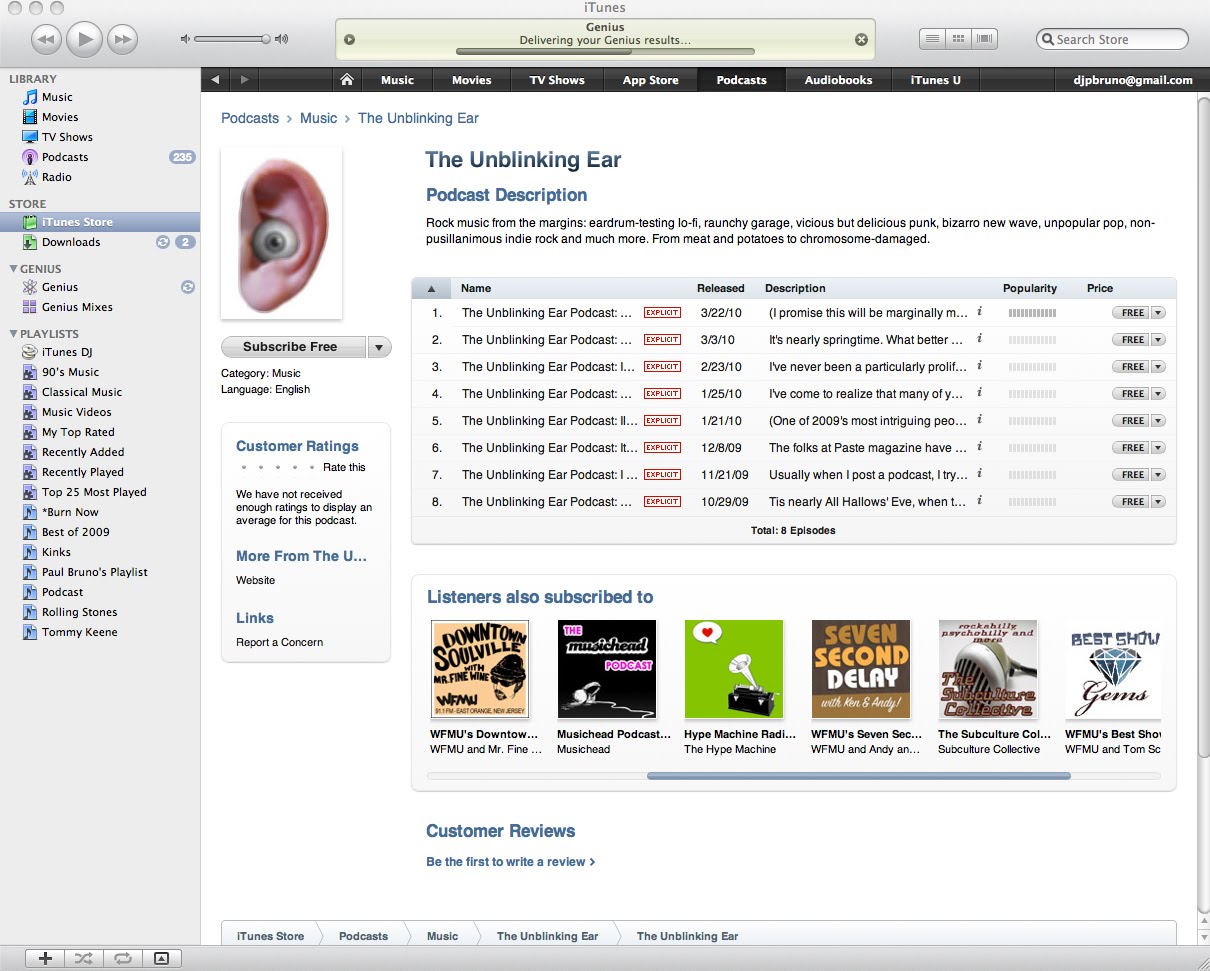
As some of you may know, this podcast is available via subscription from the iTunes store:


Terrific. Except I couldn't help but notice two things:


Let me blow those up for you. There's this:


And this:


Seriously, folks. I don't ask for much.


Download the latest The Unblinking Ear Podcast
Or Subscribe via iTunes

Tuesday, April 13, 2010

Used Bin Ubiquitous Bargains: Tommy Keene

Once a upon a time I would regularly run a feature in this digital pages called "Paleontology For Dullards," wherein I rated LPs I found in used bins with a percentage of what I paid for them. In other words, an esoteric title for a impenetrable concept.

In an effort to make this blog more user-friendly (and user-used), I've ditched this concept and it's place would like to introduce Used Bin Ubiquitous Bargains.

These are the LPs I frequently see fallowing in the used bins of record shops despite their quality and reliably low sticker price. They are the albums you can find easily, will only set you back 5 beans or less and are probably better than the whatever the hype machine is praising this week. All in all, they are ultimately both a wiser and more prudent purchase and better way to support your local vinyl vendor than most of the collector-bait that will be released on Record Store Day. MP3s from these albums will be posted as well, because I've learned that people like free songs more than reading.

For our inaugural UBUB (please pronounce this "you-bee you-bee" not "uhb uhb"), I cannot think of a more deserving candidate than Mr. Tommy Keene.

Keene was something of a critics darling back in the 80s. His pair of 1984 EPs, Back Again (Try) and Places That Are Gone, received glowing notices from big time R'n'R institutions Rolling Stone and The Village Voice. It's easy to hear why. Keene is an ace pop songwriter. A lot of what gets classified as power pop is too much pop and too little power, its practitioners favoring the slight and saccharine. That's not a problem for Keene. His melodies are seductive, never sticky-sweet. Even his most dulcet songs have the hint of a much fiercer, more primal animal. I've always imagined that when Westerberg fired Bob Stinson and tried to mold the Replacements into a less shambling, more professional unit, it was Keene's sound he was emulating. Indeed, Keene's records from this period sound like everything the post-Tim Mats should have been.

Keene's notoriety with critics led to a deal with Geffen Records where he debuted with 1986's Songs From The Film. Despite some now dated production (how high can we mix that gated snare?), the album remains one of the decade's best. Songs From The Film received a somewhat successful promotional push from Geffen, enough to get it to #148 in the Billboard charts. More importantly, it ensured that promo copies of the record have become a used bin staple for the past 20-plus years. Keene subsequently released an EP (Run Now) and another full length (Based On Happy Times) for Geffen before returning to the land of the independents, where he has happily remained since.

All of the records above can obtained without difficulty and on the cheap, with Songs From The Film being both the easiest to find and most highly recommended. Below is a sample of some of Keene's work: a song each from Back Again (Try), Places That Are Gone, Run Now and Based On Happy Times and two from Songs From The Film. Give them a listen and know that the next time you see a slab of vinyl with Keene's name on it in ye olde rekkid shoppe, you shouldn't hesitate.


Thursday, April 08, 2010

We Love Malcolm

...cause no one else does.


(Video via Jon Solomon.)

There's a lot of things you could call Malcolm McClaren: swindler, charlatan, opportunist, scam artist, provocateur, culture vulture, art school wanker, unrepentant exploiter, borderline child pornographer, shameless idea thief, narcissist. I'm sure McLaren wouldn't object to any of those being part of his epitaph.

Coincidentally, I just rewatched The Filth and the Fury a few days ago. The film certainly downplayed McLaren's contribution to his most famous association, the Sex Pistols. This was in some ways a refutation of The Great Rock 'n' Roll Swindle (ironically, also directed by Julien Temple), where McLaren positioned himself as a Machiavellian mastermind assaulting culture and the Pistols themselves as mere puppets. The truth somewhere in between. There's little doubt that McLaren's concepts shaped the Sex Pistols to some degree. At the very least, he deserves full credit for dressing them.

Beyond even that band's considerable influence, McLaren's fingerprints are all over popular culture. Consider Bow Wow Wow's Annabella Lwin then consider the early career of Britney Spears. Consider his "solo" recording "Buffalo Gals" then consider Snoop Dogg's "Drop It Like It's Hot." McLaren was obviously more an ideas man than musician but his ideas have informed music culture for the past 30-plus years. Anyone who has enjoyed a bit of post-Situationist subversion mixed in with their pop product probably has McLaren to thank.

Tuesday, March 23, 2010

The Unblinking Ear Podcast: The List (So Far)

(I promise this will be marginally more fun than filling out your census form.)

Hello, fans of my podcast, tolerators of my podcast, and tolerators of my person.

Because I have far too much time on my hands, I've assembled a list of every artist I've played on the Unblinking Ear Podcast.

Why? Well, it's sort of been my unofficial policy to never play the same artist twice. This is, of course, unless the artist has a new release, which I'm always happy to feature. I just don't like redundancy. Rather than play the same favorites over and over again, I'd much rather find and air things less appreciated, even if I'm just digging through the corners of my own record collection.

I've been doing the podcast for nearly two years and with list I will no longer have to check the tags of each post to see whom I've already played. The list features 308 different artists.

Now here's the part where you come in.

Who HAVEN'T I played?

Is there any band conspicuous by their absence? Is there someone of whom you know I'm a big fan, but isn't featured? Is there a band that you think it just so damn good you just can't believe I have played them?

Please let me know. All your responses will be considered (and possibly mocked). All kidding aside, I'm looking for your help to stimulate some dead links in my brain and make me go "Oh, man! I forgot all about them."

So get to it, folks. At the very least, I hope this will make for some lively discussion.

Oh, and if you mention your own band, I'm going to smack you in the mouth.

1. AC Newman
2. The Action
3. The Adverts
4. AK-47
5. Alan Milman Sect
6. Alternative TV
7. American Music Club
8. Angry Samoans
9. Animals and Men
10. Article 58
11. Barbara Manning
12. Bartlebees
13. Bassholes
14. The Bats
15. Beach Boys
16. The Beat
17. Better Beatles
18. Bevis Frond
19. Beyond the Implode
20. Big Star
21. Bird Nest Roys
22. The Birthday Party
23. The Bizarros
24. Blue Orchids
25. Bobby Soxx
26. Bottomless Pit
27. Box Elders
28. The Boys
29. Brain Eno
30. Busted Statues
31. Cabaret Voltaire
32. Carolee
33. Cause Co-Motion
34. Chain Gang
35. Cheap Trick
36. Cheveu
37. Chills
38. Chris Carpenter
39. Christmas
40. Chrome
41. The Chosen Few
42. Circle X
43. Classic Ruins
44. The Clean
45. Colin Newman
46. Coral
47. Coloured Balls
48. The Cramps
49. The Creation
50. The Creepers
51. The Crescendos
52. Crime
53. Cyclops
54. Daniel Francis Doyle
55. David Bazan
56. Dead Boys
57. Dead C
58. Death
59. Desperate Bicycles
60. Destroyer
61. The Dicks
62. The Dictators
63. Died Pretty
64. Dieter Meier
65. The Dils
66. Dirt Shit
67. Dirtbombs
68. Disappears
69. Distractions
70. The Dogs
71. The Dream Syndicate
72. Drunks With Guns
73. Eat Skull
74. Eddy Current Suppression Ring
75. Electric Eels
76. The Embarrassment
77. Embrace
78. Endtables
79. Eppu Normaali
80. The Ex
81. The Fall
82. Fang
83. The Feelies
84. FIlth
85. Flamin Groovies
86. Fleetwood Mac
87. Flesh Eaters
88. Flipper
89. The Fresh and Onlys
90. Fucked Up
91. Futureheads
92. Gaunt
93. Gem
94. Gene Clark
95. The Germs
96. Girls
97. The Girls
98. Girls At Our Best
99. Go-Betweens
100. Golden Error
101. Gordons
102. Grass Widow
103. Great Plains
104. Grifters
105. Guided By Voices
106. The Gun Club
107. Gun Outfit
108. Guv'ner
109. Halo of Flies
110. Hank IV
111. The Haskels
112. Thee Headcoats
113. Helmettes
114. Henry's Dress
115. Herman's Hermits
116. Home Blitz
117. Homosexuals
118. Hot Snakes
119. The Hunches
120. Hüsker Dü
121. The In Out
122. Inferno
123. Jay Reatard
124. Jean-Paul Sartre Experience
125. Joel RL Phelps and the Downer Trio
126. John Cale
127. John Felice
128. Johnny Moped
129. Johnny Thunders
130. Kevin Ayers
131. The Kids
132. The Kinks
133. Kriminella Gitarrer
134. Kurt Vile
135. La Peste
136. The Laureates
137. The Leftovers
138. The Lewd
139. Liket Lever
140. Liliput
141. Lilys
142. The Lines
143. Little Claw
144. Lollipop Shoppe
145. Long Blondes
146. Lou Reed
147. Loudon Wainwright III
148. Love
149. Love of Diagrams
150. Magick Heads
151. Magik Markers
152. Marked Men
153. The Mayfair Set
154. Mayyors
155. Mecca Normal
156. Mekons
157. Meth Teeth
158. Mick Farren
159. Micronotz
160. Minutemen
161. Mission of Burma
162. The Misunderstood
163. The Monorchid
164. Motorhead
165. Moving Sidewalks
166. Moving Targets
167. The Mystic Tide
168. Nasal Boys
169. The Nazz
170. Negative Approach
171. Negative Trend
172. Neil Young
173. The Nerves
174. Neu
175. New Bomb Turks
176. Nitwitz
177. Nocturnal Projections
178. Nodzzz
179. Nothing Painted Blue
180. Nothing People
181. Nubs
182. The Obits
183. The Only Ones
184. Opus
185. The Oranges Band
186. Oxford Collapse
187. The Pagans
188. Pere Ubu
189. Phil Ochs
190. Photobooth
191. The Pin Group
192. Pissed Jeans
193. Polvo
194. Ponys
195. The Pop Group
196. Prisonshake
197. Psychic Ills
198. Public Image Ltd
199. Pylon
200. Randoms
201. Real Kids
202. Red Krayola
203. Red Transistor
204. Reigning Sound
205. Richard Hell
206. Richard Thompson
207. The Rich Kids
208. Rip Offs
209. Robert Wyatt
210. Roger Miller
211. Roky Erickson
212. Ron House
213. Ronnie Mayor
214. Rose Tattoo
215. Rot Shit
216. Roy Wood
217. Rude Kids
218. The Ruts
219. Sado-Nation
220. The Saints
221. Sally Crewe and the Sudden Moves
222. Satan's Rats
223. Screaming Urge
224. Sebadoh
225. Severe
226. Sharon Jones and the Dap Kings
227. Shop Assistants
228. Sic Alps
229. Silkworm
230. Silver Apples
231. Simply Saucer
232. Singles
233. Skrewdriver
234. Slant 6
235. Sleater Kinney
236. The Sleepers
237. Snuky Tate
238. Soft Boys
239. Sonic Youth
240. Sonic's Rendezvous Band
241. Spider Bags
242. Spoon
243. Spring
244. The Squad
245. Stiffs Inc
246. The Stooges
247. The Stranglers
248. Strapping Fieldhands
249. Stuart Murdoch
250. Styrenes
251. Sugar
252. Suicide Commandos
253. Superchunk
254. Swamp Rats
255. Tall Dwarfs
256. Tampax
257. Tapeworm
258. Ted Leo and the Pharmacists
259. Teenage Fanclub
260. Terrorways
261. Thee Oh Sees
262. Thermals
263. This Poison!
264. Third Bardo
265. Thomas Function
266. Thomas Jefferson Slave Apartments
267. Thought Criminals
268. Tights
269. Times New Viking
270. Tommy Keene
271. Tre Orsi
272. Troggs
273. Twink
274. Twinkeys
275. Ty Segall
276. Tyvek
277. Unrest
278. Urinals
279. Uzi
280. V-3
281. Vaselines
282. Vast Majority
283. Vee Dee
284. Versus
285. Vicious Visions
286. The Victims
287. Victor Dimisich Band
288. Vivian Girls
289. Vomit Launch
290. Vomit Pigs
291. Volcano Suns
292. Vulgar Boatmen
293. Wanda Jackson
294. Wavves
295. The Wedding Present
296. Weirdos
297. The What's New
298. The Wipers
299. Wire
300. Wounded Lion
301. Wooden Shjips
302. X
303. XYX
304. Yo
305. Yo La Tengo
306. Young Marble Giants
307. The 3Ds
308. 45 Grave